
Have you had difficulty defecating or emitting gas for more than 24 hours? Then it’s time to see your doctor, because you most likely have a bowel obstruction.
The good news is that it is possible to prevent this very scary disease!
Recognizing symptoms such as dry mouth or abdominal bloating will allow you to solve bowel obstruction problems at home, without having to go to your stomatherapist or even the emergency room.
Below we explain what the symptoms of an intestinal blockage are, how to recognize and prevent them, and possibly what to do (and NOT to do) if you are certain you have an obstruction.
Twenty-three out of every 100* ostomates have experienced an intestinal blockage at least once. The most common symptoms are stomach pain, dry mouth, and a feeling of abdominal bloating. To deal with a blockage, you can try increasing fluid intake, keeping the abdomen warm, and gently massaging the abdominal muscles.
If you don’t notice signs of improvement, contact your stomatherapist or go to the emergency room.*
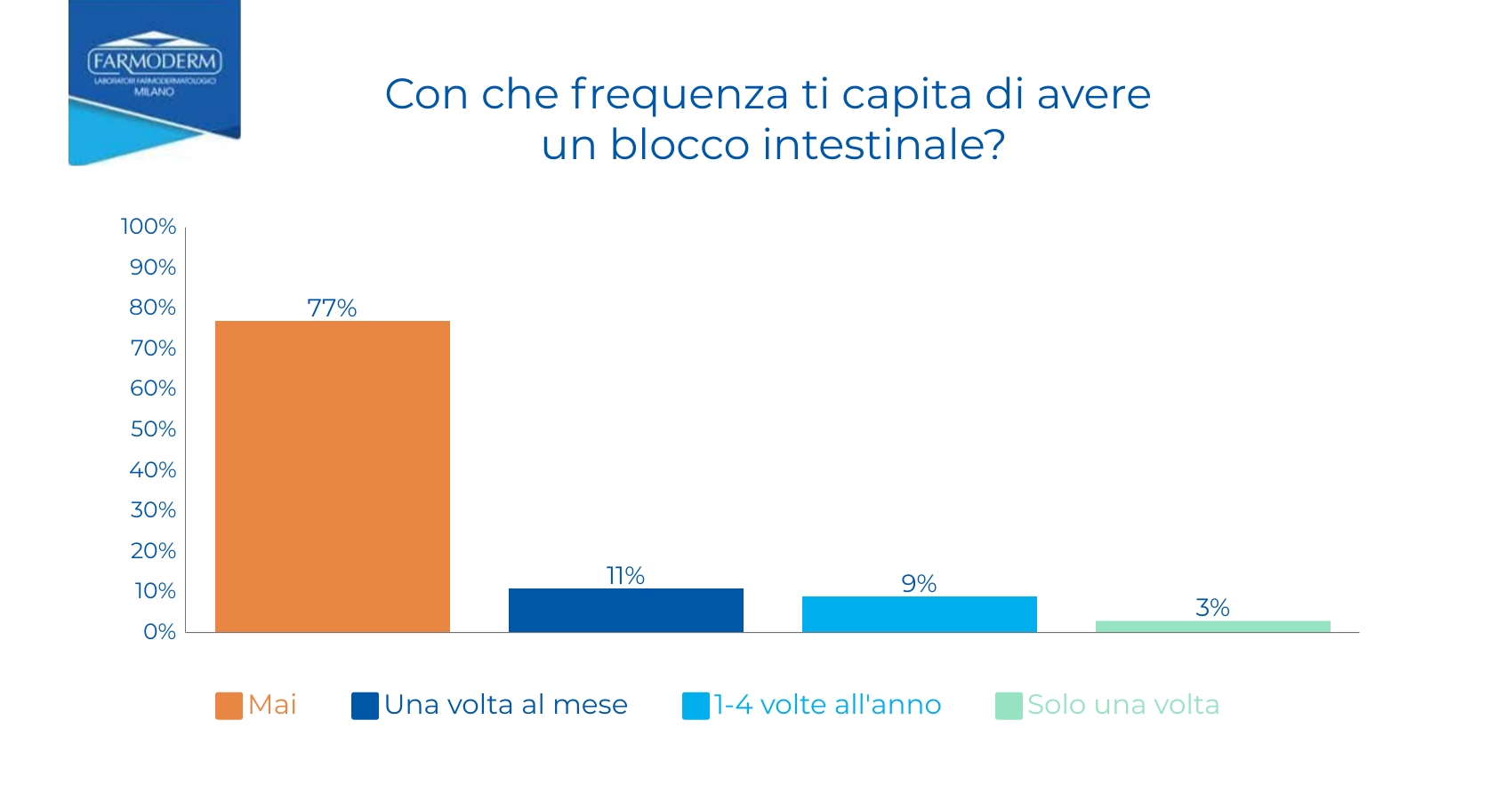
This survey was conducted in April 2021 and was answered by 57 people of different nationalities. The survey was posted in the following Facebook group, “Ileostomy,colostomy, stoma and bowel support”
Table of Contents:
- Some relevant information about intestinal blockage
- Symptoms of an intestinal blockage
- After how long does the first symptoms of a possible bowel obstruction occur?
- Different types of intestinal occlusions
- The causes of an intestinal blockage
- The treatment of intestinal obstruction
- What happens in the hospital?
- How to solve the problems of trapped air?
- How to prevent intestinal blockage? Diet recommendations
- Frequently asked questions
Some relevant information about intestinal blockage:
The most common causes of intestinal blockage with ostomy are poorly digested food and improper ostomy care.
Total bowel obstruction requires immediate medical attention.
If you have an ileostomy, symptoms of a possible intestinal blockage will appear almost immediately. With a colostomy, symptoms may appear after several hours.
How can I tell if I have an intestinal blockage with my ostomy?
With an ostomy, to tell if you are having an intestinal blockage, just look at your collection system: if it remains empty for quite a long time, especially after several meals, then it is very likely to have an occlusion.
In addition, you may also experience some of these symptoms:
- Pain and intense stomach cramps
- Poor evacuation or constipation
- Swollen stomach
- Nausea
- Vomiting
- Abdominal bloating
- Dry mouth
- Low urine output
- Low appetite
After how long does the first symptoms of a possible bowel obstruction occur?
An intestinal obstruction, especially for people with colostomy, may not manifest some symptoms until several hours later.
These may be the first symptoms you notice:
- Feeling of fullness or strong pressure in the pelvic area
- Severe abdominal cramps
- Pain in the epigastric region
- Pain that spreads to the back
With an ileostomy, the first symptoms of an intestinal blockage formation appear almost immediately. And often after only a few hours, this blockage, could become dangerous to your health.
A blocked ileostomy occurs quickly for anatomical reasons: it is located in the small intestine, where stool has not yet formed. Therefore, do not overlook cramping, which could be a warning bell.
Different types of intestinal occlusions
There are two main types of intestinal occlusions with ostomy – partial occlusion and total occlusion:
- Partial occlusion: a partial occlusion of the bowel may allow some liquids or gases to reach the collecting system. As a result, you may notice some liquid or slimy (mucus-like) contents in the pouch, but no stool.
- Total occlusion: a total occlusion does not allow any kind of substance to reach your ostomy pouch, which will be empty.
<h2id=”blockage5″>What are the causes of intestinal blockage?The most common causes of intestinal blockage are:
- Poor hygiene of the ostomy and peristomal skin
- Poorly digested food
- Local inflammation
- Twisted colon
- Strangulation of the intestine due to parastomal or abdominal hernias
- Bowel adhesions due to previous surgery.
It is important to have a healthy peristomal skin, not only to avoid a possible intestinal blockage, but also to prevent any kind of problem related to peristomal skin, stoma, or presidium damage.
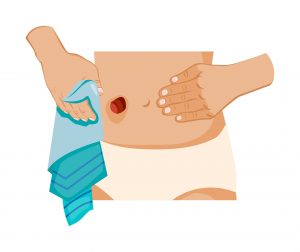
So, if you want to have healthy peristomal skin, a perfect hygiene routine is essential. But how to do it?
In this article we reveal all the details for a perfect peristomal skin hygiene routine in just 10 easy steps.
What can I do to unblock the bowel?
Although many people claim that it is possible to manage and resolve an intestinal blockage at home, trying to do so could be very dangerous. To properly treat an intestinal blockage, go to a hospital, where you will receive proper care and attention.
Neglected bowel obstruction could lead to possible perforation of the intestinal wall. The health of your intestines depends on the frequency of your evacuations and the quality and quantity of your stool.
A sluggish bowel could indicate a possible risk of obstruction. As a general rule, there are some things you can and some things you should not do when you have a blocked bowel.
Things to DO and NOT to DO for the treatment of intestinal obstruction:
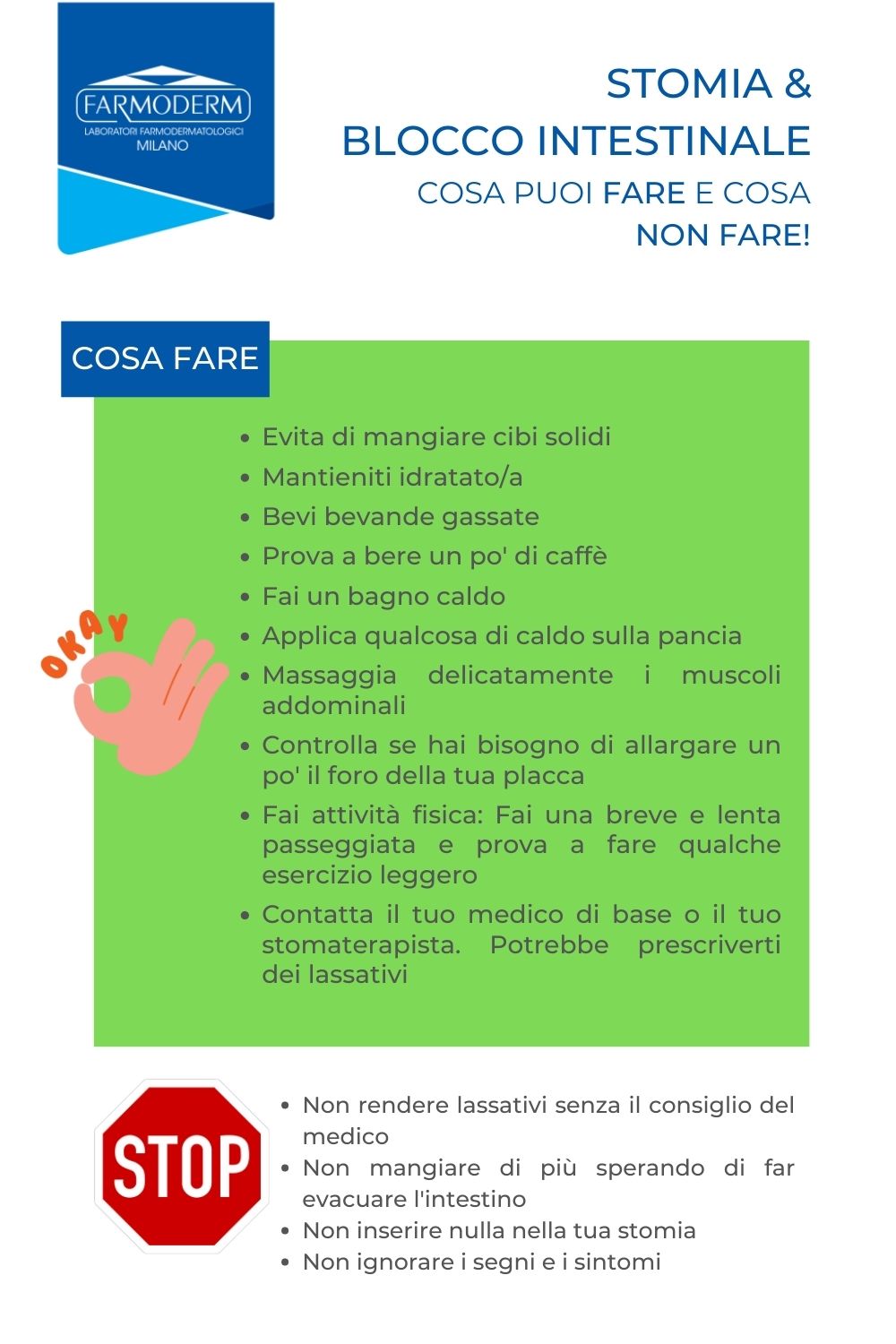
Whatever type of ostomy you have, do not do any of the following:
- Taking laxatives without medical advice.
- Eating more hoping to evacuate the bowels.
- Insert anything into your stoma.
- Ignore the signs and symptoms.
The following is a list of things you might do at home when you suspect a bowel obstruction:
- Avoid eating solid foods.
- Keep hydrated by increasing fluid intake such as hot tea or fresh fruit juices. Carbonated beverages, such as coke, might also help with partial intestinal blockages. However, they do not seem to be helpful for total blockages, as gas production would increase, causing abdominal pain to increase.
- Try drinking some coffee. Although for some people coffee is not the best drink to drink (because of its stimulating effect on the intestines, which could lead to painful bowel contractions), for many people it is a great solution.
- Take a warm bath to relax abdominal muscles.
- Apply something warm to your belly to allow your abdominal muscles to relax.
- Gently massage the abdominal muscles so as to relax and encourage bowel movements.
- Do physical activity. Take a short, slow walk and try some light exercises, lifting your knees to your chest.
- Check to see if you need to enlarge the hole in your plate a bit. A plaque that is too tight, could strangle your stoma, causing it to swell and consequently a possible intestinal blockage.
- Contact your primary care physician or stomatherapist. He or she may prescribe laxatives for you. Avoid taking laxatives without first consulting the advice of your doctor or stomatherapist.
What happens in the hospital?
When you arrive at the hospital, the doctor will review your medical history and perform a physical examination.
Next, they will take an X-ray or ultrasound of your abdomen to look for signs of bowel obstruction.
If your doctor suspects dehydration, he or she will suggest that you undergo a blood test and may give you intravenous fluids and electrolytes.
If you arrive at the hospital with nausea or vomiting, they may give you some anti-nausea medication and may insert a nasogastric tube (through your nose) into your stomach. This tube will relieve the symptoms of nausea and vomiting.
The medical team will keep you in the hospital without food, fasting until bowel movements are felt that indicate resolution of the problem.
Once your blockage is resolved, they will recommend a specific diet to reactivate your bowel function.
However, in cases of severe bowel obstruction, surgery may be the only solution.
How to solve the problems of trapped air?
Some people may feel bloated and have abdominal cramps because of gas trapped in the digestive system. To avoid unpleasant consequences, be aware of what you eat.
Below we provide our advice:
Avoid ingesting foods that cause excessive air production in the belly.
Although these foods may be healthy, they may not be the right ones to consume at this specific time in your life.
Also, avoid high-fiber foods that are more prone to create a blockage, due to the undigested parts of food. Although chewing well is a golden rule, we recommend that you remove the peel from fruits and vegetables because it is difficult to digest and could cause you to have a bowel blockage.
How to prevent intestinal blockage? Diet recommendations

General recommendations suggest that the sooner you start eating again after surgery, the faster your intestines will function. one of the basic general rules is to chew each and every bite well.
Most surgeons suggest eating anything before and after surgery, the important thing is that it is healthy, easily digested and well chewed.
However, it is crucial that you learn to recognize and correctly interpret the signals your body sends you, and thus understand which foods are good for you and which to avoid.
Don’t forget that a healthy portion of food is not always easily digestible.
General suggestions for preventing stoma blockage include the following:
- Eat frequent, small portions of food to help your gut recover
- Eat soft, easily digestible foods
- Pay special attention to chewing food well
- Supplement your diet with extra protein and vitamins, especially if your appetite is poor
- Increase fluid intake, especially water and fresh fruit juices
- Start with easy foods, such as yogurt
In addition to this, we suggest that you regularly use the Bioderm Stoma Plus, as this ostomy-specific cleanser prevents your skin from becoming irritated and further aggravating the problem.
Frequently asked questions
Still haven’t found the answer to your question? Below, we have collected the most frequently asked questions related to intestinal blockage:
How long can an intestinal blockage last?
An intestinal blockage can last from a few hours to several days unless it resolves itself or you go to the hospital.
Waiting a long time could pose a serious health risk. In general, an intestinal blockage for a colostomy patient may last longer than an ileostomy one because of the different anatomical and functional functions of the small intestine.
What happens when a stoma stops working?
When an ostomy stops working, you may experience symptoms and detect some signs of bowel obstruction.
Your ostomy bag will probably be empty, and you may experience abdominal bloating, have stomach pain, and may notice a swollen ostomy.
How often do evacuations occur with a colostomy?
People with a colostomy usually empty their pouch about 6-8 times a day.
However, the frequency of evacuations depends on what and how often you eat. There is no general rule about how often a colostomy should discharge.
How do you get rid of an intestinal blockage with an ileostomy?
To get rid of a bowel obstruction you need to adjust your diet, drink plenty of fluids and try to manually relax your abdominal muscles. Also try to do some light physical activity.
Finally, avoid laxatives because you are at high risk of dehydration. If the blockage lasts too long, contact your stomatherapist or go to the hospital.
What do you feel with an intestinal blockage with an ileostomy?
For people with an ileostomy, an intestinal blockage causes stomach cramps combined with a feeling of bloating in the abdomen.
You may also experience discomfort and see changes in your ostomy (e.g., bloating). In addition, coughing may cause you to feel pressure in your stomach area.
How do I know if my ostomy is blocked?
If your pouch remains empty for several hours, even after meals, you most likely have an intestinal blockage.
Other signs include abdominal pain, swelling of the stoma, nausea, vomiting, and bloated feeling.
Adjust your diet and follow the above suggestions, however, if you do not see signs of improvement, contact your referring doctor or go to the hospital.
Can I have a bowel obstruction if I keep having evacuations?
A partial blockage may allow some contents (especially liquids) to reach the bag. With a total blockage, your collection system will remain empty.
What foods cause ostomy blockage?
Foods that cause ostomy blockage are those that you do not digest well. Often, foods that are high in fiber are more likely to cause a blockage than foods that are soft in texture and lack fiber.
If you fear intestinal blockage, you should temporarily stop eating foods that are known to thicken stools such as bread, rice, pasta, marshmallows, and bananas.